I am a Ph.D. student in Computing Science at Simon Fraser University, supervised by Dr. Ali Mahdavi-Amiri. My research interests include computer vision, computer graphics, generative modeling, self-supervised learning, machine learning theory, and representation learning.
My current research focuses on 3D-aware hair modeling from images, and I also work part-time as a Machine Learning Engineer with the VanityAI team at MARZ. Previously, I earned my B.Sc. in Computer Engineering from Sharif University of Technology, where I worked on multimodal learning and machine learning theory.
Before SFU, I spent two years at Tapsi as a Software Engineer and Data Scientist. I was also awarded a silver medal at the 13thInternational Olympiad on Astronomy and Astrophysics in 2019, after earning a gold medal and ranking first in Iran’s national olympiad.
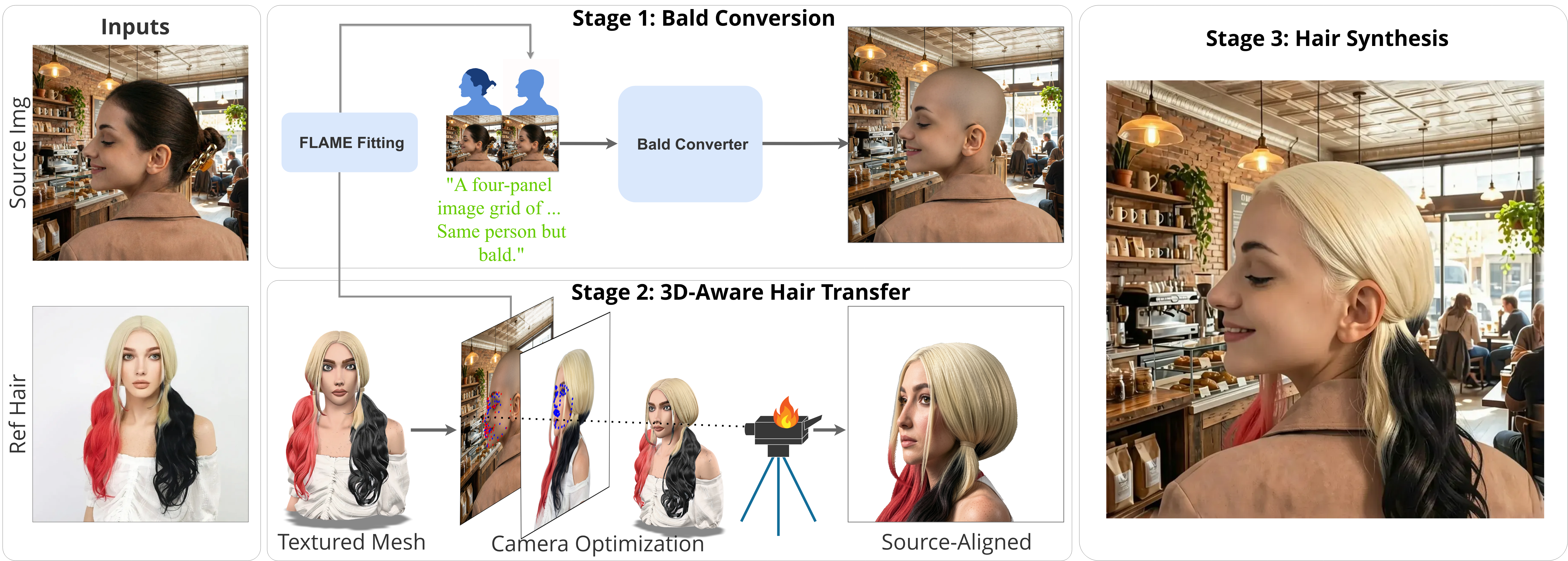
Transferring hairstyles between images is an important but challenging task in computer graphics, computer vision, and visual effects. Most prior works operate best under small pose gaps and fall short under large viewpoint and scale differences, where missing hair content must be synthesized rather than transferred. We present HairPort, a 3D-aware framework for in-context hairstyle transfer from a single reference image. Our staged pipeline first removes the source hair while preserving facial identity, then reconstructs and re-renders the reference hairstyle from the target viewpoint, and finally synthesizes the result using flow matching conditioned on the bald source, the aligned hair rendering, and the reference image.
@inproceedings{heidari2026hairport,title={HairPort: In-context 3D-aware Hair Import and Transfer for Images},author={Heidari, Alireza and Alimohammadi, A. and Mahdavi-Amiri, A.},booktitle={ACM SIGGRAPH 2026 Conference Papers},year={2026},doi={10.1145/3799902.3811046},publisher={Association for Computing Machinery}}
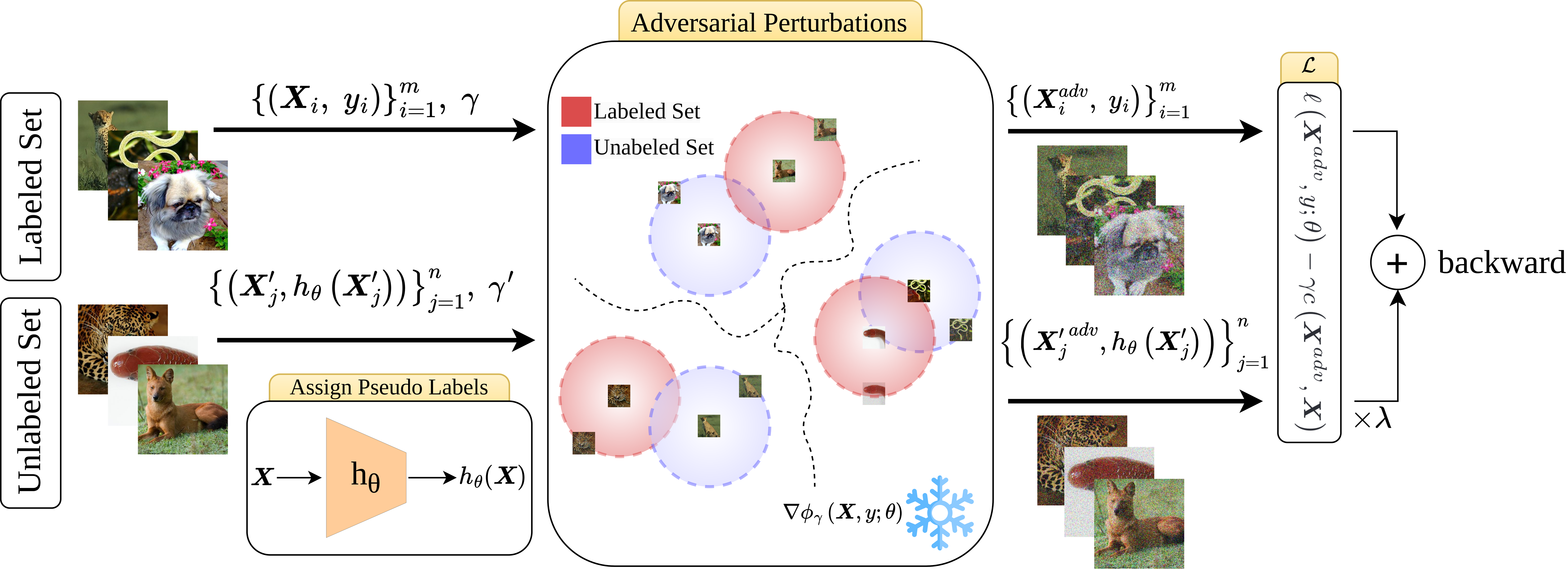
We propose a novel framework for incorporating unlabeled data into semi-supervised classification problems, where scenarios involving the minimization of either i) adversarially robust or ii) non-robust loss functions have been considered. Notably, we allow the unlabeled samples to deviate slightly (in total variation sense) from the in-domain distribution. The core idea behind our framework is to combine Distributionally Robust Optimization (DRO) with self-supervised training. As a result, we also leverage efficient polynomial-time algorithms for the training stage. From a theoretical standpoint, we apply our framework on the classification problem of a mixture of two Gaussians in ℝd, where in addition to the m independent and labeled samples from the true distribution, a set of n (usually with n≫m) out of domain and unlabeled samples are given as well. Using only the labeled data, it is known that the generalization error can be bounded by ∝(d/m)1/2. However, using our method on both isotropic and non-isotropic Gaussian mixture models, one can derive a new set of analytically explicit and non-asymptotic bounds which show substantial improvement on the generalization error compared to ERM. Our results underscore two significant insights: 1) out-of-domain samples, even when unlabeled, can be harnessed to narrow the generalization gap, provided that the true data distribution adheres to a form of the “cluster assumption", and 2) the semi-supervised learning paradigm can be regarded as a special case of our framework when there are no distributional shifts. We validate our claims through experiments conducted on a variety of synthetic and real-world datasets.
@inproceedings{saberi2024outofdomain,title={Unlabeled Out-of-Domain Data Improves Generalization},author={Saberi, Amir Hossein and Najafi, Amir and Heidari, Alireza and Movasaghinia, Mohammad Hosein and Motahari, Abolfazl and Khalaj, Babak},booktitle={The Twelfth International Conference on Learning Representations},year={2024},url={https://openreview.net/forum?id=Bo6GpQ3B9a},publisher={International Conference on Learning Representations}}